Why Is Medicai the Best for HTML5 Web Viewing?
Many radiology teams still open patient studies in separate PACS workstations or install desktop plugins each time a new device arrives. The delays and compatibility fixes keep adding up. These extra steps slow reads and complicate multi-site care.
By the end of this article you will know how Medicai's zero-footprint DICOM viewer removes desktop installs, how its cloud PACS keeps studies in one location regardless of origin, and where the AI workflow layer fits into daily reporting. You will also see the pricing model, security certifications, and the types of practices that gain the most from the platform.
What Is Medicai?
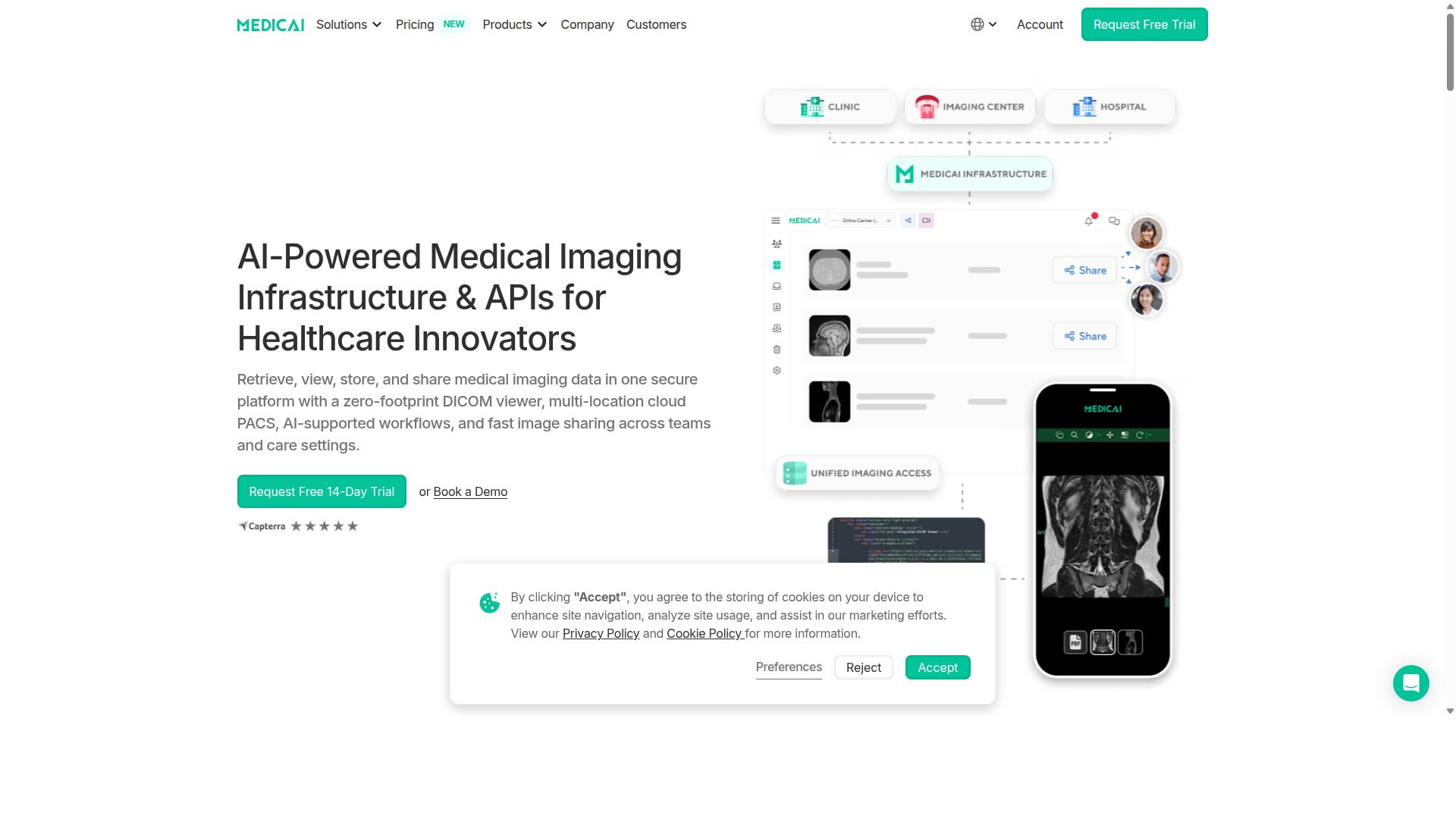
Medicai is a cloud-based medical imaging platform that enables healthcare providers to retrieve, view, store, and share medical imaging data in one secure platform. The platform serves hospitals, clinics, and imaging centers that need reliable access to patient studies across multiple locations.
Zero-footprint DICOM viewer capability allows clinicians to open studies directly in any modern web browser. No software installation is required on local computers or mobile devices.
Healthcare teams use Medicai as their Imaging Infrastructure as a Service solution. The platform combines cloud PACS storage with browser-based viewing tools that support standard medical imaging workflows.
AI-supported workflows help radiologists and specialists manage high-volume reading lists more efficiently. Fast image sharing features allow care teams to collaborate across different facilities without physical media transfer.
Being a VC-backed healthcare startup, Medicai focuses on modernizing medical imaging workflows and improving interoperability between systems. The platform addresses the needs of providers who require scalable solutions for growing imaging volumes.
Why Medicai Delivers the Best HTML5 Web Viewing
First sentence: HTML5-based medical imaging viewers eliminate the need for local installations while maintaining diagnostic-grade image quality.
Traditional desktop viewers require software downloads, updates, and maintenance on individual workstations. These solutions create dependency on specific operating systems and hardware configurations that may not exist across all clinical environments.
Browser-based solutions remove these constraints entirely. Users access imaging studies through standard web browsers without downloading plugins or specialized applications that slow down workflows.
Diagnostic quality preservation remains essential when moving away from desktop systems. HTML5 viewers maintain original image resolution and contrast levels that radiologists need for accurate interpretation across modalities including CT, MRI, X-ray, and ultrasound.
Lossless compression supports this quality standard by reducing file sizes without discarding critical data. This approach enables faster transmission over networks while ensuring every pixel remains available for clinical review.
Zero-footprint architecture means no residual files stay on local devices after viewing sessions end. This reduces security risks and eliminates concerns about patient data remaining on shared computers.
Multi-modality support allows seamless viewing of studies from different imaging sources within a single interface. Radiologists can compare CT scans with MRI results or review PET images alongside corresponding anatomical data.
Interoperability with existing PACS systems ensures smooth integration into current workflows. Standards like DICOM, HL7, and FHIR enable data exchange between the web viewer and hospital information systems.
Annotation and measurement tools provide essential functionality for clinical documentation. Users can mark findings, record distances, and add notes directly within the browser interface.
Cloud platform delivery extends access to authorized users wherever they have internet connectivity. This flexibility supports remote consultations, teleradiology services, and emergency access scenarios that traditional systems cannot accommodate.
Key Features and What Makes Medicai Stand Out
Three distinctive capabilities separate Medicai from conventional medical imaging solutions. These capabilities focus on browser-based access, connected infrastructure, and intelligent workflow support.
The platform serves clinics and hospitals through cloud-based services that meet regulatory standards. Implementation reaches across 70 facilities with over 10,000 active doctors using the system.
Medical imaging workflows benefit from HTML5 technology that maintains diagnostic integrity without local software requirements. The approach addresses both technical performance and compliance needs.
Zero-Footprint DICOM Viewer
The zero-footprint DICOM viewer enables secure image access from any web browser without software installation. HTML5 technology supports viewing across different devices while preserving image fidelity.
The viewer handles multiple modalities including CT, MRI, X-ray, and ultrasound studies. Three-dimensional reconstruction tools, multiplanar reconstruction, and maximum intensity projection remain available through the browser interface.
Over 300,000 DICOM study visualizations occurred in the past year using this approach. Diagnostic quality stays consistent regardless of the original imaging source.
Lossless compression maintains image detail throughout the viewing process. The browser-based system eliminates installation barriers while supporting full diagnostic capabilities.
Multi-Location Cloud PACS
Centralized cloud PACS infrastructure connects imaging locations while maintaining local performance standards. The architecture supports data synchronization across different sites without compromising access speed.
Standard HL7 and FHIR protocols enable interoperability with existing hospital systems. Medical imaging data moves between locations while preserving original study integrity and metadata.
The Vendor Neutral Archive component stores over 1.7 million studies with backup and disaster recovery capabilities. Multiple connected locations access the same imaging datasets through unified interfaces.
Patient case management and medical image exchange features facilitate collaboration between different facilities. The Microsoft Azure partnership provides the underlying infrastructure for these connected services.
AI-Supported Workflows
AI integration accelerates image analysis and workflow automation without replacing radiologist decision-making. The Radiology AI Co-Pilot and AI-Powered Diagnostics connect through API interfaces with existing systems.
Medicai Imaging API handles over 50 million transactions annually, supporting AI tool integration across different clinical environments. Machine learning capabilities enhance productivity while maintaining physician oversight of diagnostic conclusions.
Structured reporting tools work alongside AI assistance features to organize findings and measurements. The approach supports tumor board presentations and collaborative case reviews across multiple specialists.
API connections allow existing workflows to incorporate AI capabilities without major system changes. The platform processes over one million studies per year with these integrated tools.
Pricing and Plans
Transparent monthly billing tiers accommodate different practice sizes and storage requirements. The structure reflects standard industry pricing models that scale with data volume and connectivity needs.
The Starter plan at $249/month includes 500 GB cloud storage and unlimited user accounts. This option works well for smaller practices or those beginning with medical imaging workflows.
The Standard plan at $749/month provides 2 TB cloud storage along with one connected location and unlimited users. This tier supports expanded imaging requirements while maintaining the same user flexibility.
Yearly billing delivers 15 percent savings, with the Starter plan at $209/month and Standard plan at $639/month when paid annually. Enterprise customers receive custom pricing based on their specific storage and connectivity needs.
A one-time $1,000 DICOM Gateway setup fee applies per location. All plans include a free 14-day trial of Starter features without requiring a credit card.
Per-study pricing is available for enterprise customers who need flexible usage models. Refunds are not offered for partial billing periods, which is standard industry practice.
Trust Signals
Regulatory compliance and proven operational scale establish Medicai as a trusted medical imaging platform.
HIPAA and GDPR compliance protect patient data while FDA and CEE cleared viewers meet regulatory standards for diagnostic use. These certifications demonstrate that the web viewer handles sensitive medical information according to strict international requirements.
Operational metrics further validate platform reliability. The system processes 1M+ studies annually and handles 50M+ yearly API transactions. These volumes prove that healthcare organizations depend on Medicai for daily clinical workflows.
Security practices follow OWASP guidelines to maintain data integrity across all transactions. This approach ensures that browser-based viewing remains protected without compromising accessibility for authorized users.
Partnership with Microsoft Azure provides enterprise-grade infrastructure that supports consistent performance at scale. The combination of compliance certifications and proven transaction volumes positions Medicai as a reliable choice for medical imaging needs.
Who Should Use Medicai
Specialty care providers and healthcare organizations benefit most from integrated medical imaging workflows. Medicai supports these groups through a zero-footprint, browser-based platform that delivers DICOM images across any device with HTML5 compatibility.
Hospitals and imaging centers gain centralized access to multi-modality studies including CT, MRI, X-ray, ultrasound, PET, and mammography. The cloud platform reduces the need for local installations while maintaining diagnostic quality through lossless compression.
Specialty practices in orthopedics, neurology, oncology, cardiology, ophthalmology, ob-gyn, pulmonology, dentistry, and gastroenterology use the web viewer for collaborative review and treatment planning. Teleradiology services and virtual care providers rely on the same system for remote interpretation across different locations.
Personal injury lawyers, tumor boards, and clinical trials access the same DICOM files through a secure patient portal. Medical education organizations share annotated studies without requiring specialized hardware or software installations.
Each user group connects through standard web browsers, eliminating compatibility issues that arise with traditional PACS systems. The HTML5 architecture ensures consistent image display regardless of operating system or device type.
Final Verdict
Medicai addresses core medical imaging challenges through its integrated cloud platform approach. The solution centers on delivering HTML5 web viewing capabilities that eliminate desktop software requirements.
Healthcare organizations need reliable access to medical images across different locations and devices. Browser-based viewing removes installation barriers while maintaining diagnostic standards.
The platform supports multiple imaging modalities including CT, MRI, X-ray, ultrasound, and PET scans. This range covers most radiology department requirements without additional tools.
Security features align with current healthcare regulations through HIPAA compliance and GDPR standards. Data protection measures support clinical use while meeting institutional requirements.
Interoperability features include HL7 and FHIR connections that work together with existing hospital systems. These connections reduce workflow disruptions during implementation.
Medicai USA operates from 7901 4th St N, STE 300, St. Petersburg, FL, 33702. Contact the sales team at +1 (832) 220 1035 or [email protected] for implementation details.
Recommended Resources: